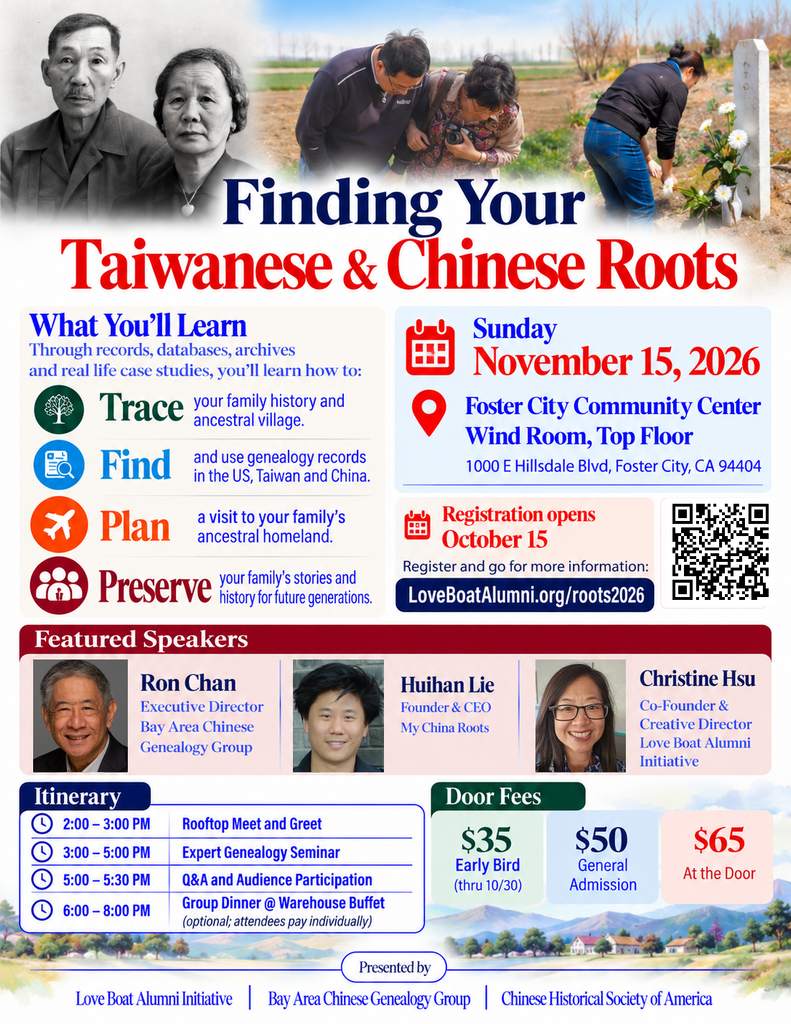
Join us for the seminar “Finding Your Taiwanese & Chinese Roots” on Nov 15, 2026. Discover how genealogy, records, archives, and family stories can help you trace an ancestral village and uncover connections between the United States, Taiwan, and China. If your ancestors came directly to the US from China we will be covering research using the National Archives, US Census, military, and applying for A and C files. Expert speakers will share practical strategies for finding genealogy records, researching family history, planning a visit to an ancestral homeland, and preserving stories for future generations. Whether beginning your family history journey or an experienced researcher, this seminar offers resources, real-life case studies, and inspiration to help you connect with your heritage. LoveBoatAlumni.org/roots2026.
Many of you have been following the proposed closure of the National Archives facility in San Bruno. As the discussion continues, we want to make sure our community’s voice is heard. BACGG’s Executive Committee has written the letter below to express our concern about losing local access to Chinese immigration records and other family histories.
One simple way to help is to sign the petition to save the San Bruno Archives. If you would like to do more, you can use our letter below as a guide and send a brief message in your own words.
Thank you for helping protect access to these records for our families and future generations.
BACGG Executive Committee
Ron Chan Founder and Executive Director Bay Area Chinese Genealogy Group Bacgg.ron@gmail.com September 27, 2026
Dr Bradford P. Wilson National Archives and Records Administration (NARA) 8601 Adelphi Road College Park, MD 20740 ArchivistOfTheUnitedStates@nara.gov
Dear Dr. Wilson:
On behalf of the 393 members of the Bay Area Chinese Genealogy Group (BACGG), we strongly oppose the planned closure of the National Archives at San Francisco in San Bruno, California, and the National Archives facility in Chicago.
The San Bruno and Chicago facilities are important resources for genealogists, family historians, educators, students, veterans, and families researching their history. Their collections include Asian immigration records, Alien Case Files (A-Files), military records, Native American records, and other materials essential to understanding and documenting our nation’s history.
For Asian American families in particular, these records provide a remarkable bridge between our earliest Asian American ancestors and their descendants today. They allow us to move beyond names and dates to discover the documents, experiences, relationships, and stories that connect generations and preserve a rich and often overlooked part of American history.
While digitization has improved access to many records, it cannot replace access to original documents. Many records have not been digitized, and genealogists often need to examine original files and related documents that are not available online. Moving these collections away from the communities they serve will make research more difficult and costly for the public.
We respectfully ask NARA to reconsider these closures, provide greater transparency about the future of these collections, and engage with the researchers and communities who depend on them.
These are not simply government records. They are primary sources of American family history—the evidence that allows descendants to discover where their families came from, how they became part of this nation, and how their stories contributed to the history of the United States.
The National Archives belongs to the American people. We hope NARA will preserve not only these important records, but also meaningful public access to them.
Sincerely
Ron Chan Founder and Executive Director Bay Area Chinese Genealogy Group (BACGG)
BACGG Executive Committee
Bruce Chin, Gail Chong, Doris Dare, Calvin Fong, Leona Lau, Tom Loui, Allan Low, Jeannie Young
Dates:Tuesday thru Thursday – February 2 – 4, 2027 8:30 AM – 5 PM
Venue: Gold Coast Hotel & Casino, 4000 W Flamingo Rd, Las Vegas, NV 89103
Registration Cost: $450 registration fee to defray the cost for the workshop and associated fees
Hotel: Reserved block of rooms $80 per night / 4 nights = $320 inclusive of taxes & resort fee & with option to book up to 3 days before and/or up to 3 days after the workshop. Free parking. Chinatown with 150 + bakeries, dim sum, restaurants, and Asian food stores are 1 mile away.
This workshop provides insightful information on Chinese genealogy research. It educates attendees on how to use various techniques like Optical Character Recognition (OCR) & Artificial Intelligence (AI) are used to advance their own research and discover the interesting information pertaining to their family / clan history and to identify those resources that can best serve them. They will be exposed to various information, material, and tools available on the Internet and in books and other sources to assist in compiling and documenting Chinese lineages.The ancestral villages of attendees will be identified and located – the primary source for family genealogy books.
This is a “how to” workshop that educates you on what you need to know to start performing Chinese genealogical research and/or visiting your ancestral village in China. The intent of the workshop is to educate people – so they can start researching and compiling their Chinese genealogy lineage – without having to be Chinese literate. Chinese narratives, annotations, and histories may require translation. Translators at the workshop to help with limited translations. Please bring your family genealogy information & lineages and let our expert researchers with years of experience in Chinese genealogy research assist you.
This is a 3-day workshop – Presentations, RoundTable interactions with presenters & experts, and Hands-On Tutorials
Registration: Please contact Henry Tom [ Tomclan@Gmail.com] 480 980 8715 to register – there is a $450 registration fee to defray the cost for the workshop and associated fees. After January 8, 2027, no refunds and the registration fee: $500 per person for mail in or on-site registrations.
Workshop registration deadline and hotel booking cut-off date is January 8, 2027
Castro Valley Library, 3600 Norbridge Ave, Castro Valley, CA, September 20, 2026, 2PM – 4PM
What You Will Learn
Utilize AI for oral history, scanning, photo restoration, and management
Explore case studies for weaving family sagas with multimedia
Discover free resources and best practices for legacy preservation
Learn tools for creating a digital family heritage library
Abstract
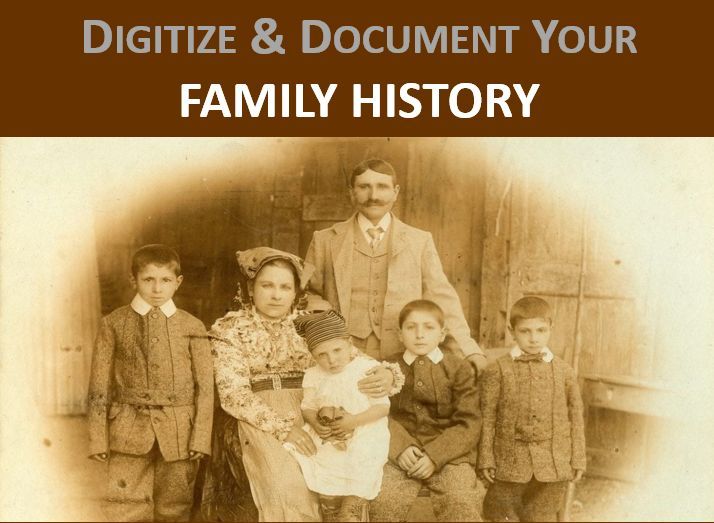
How To Digitize & Document Your Family History Dive into a realm where physical artifacts meet virtual storytelling. This session immerses you in the art of utilizing artificial intelligence for oral history creation, scanning, photo restoration, photo management, movie making and storytelling. Explore real-life case studies illustrating how to intricately weave your family’s saga using multimedia methodologies. Discover invaluable free resources and best practices to preserve your family’s legacy. By session end, you’ll learn about tools and techniques to create a digital family heritage library, that will be a timeless treasure for generations to come.
About The Speaker: Ron Chan
Ron Chan is a passionate storyteller, educator, and recognized leader in Chinese American genealogy. As Founder and Executive Director of the Bay Area Chinese Genealogy Group (BACGG), Ron inspires people to discover their family roots, preserve their heritage, and ensure the stories of those who came before them are never lost. A seasoned lecturer and published genealogy author, he brings genealogy, history, technology, and storytelling together to make family history engaging and accessible. Ron is also co-founder of the Chinese American GI Project, preserving the stories of Chinese American veterans. In 2026, Ron received the prestigious National Genealogical Society Rabbi Malcolm H. Stern Lifetime Achievement Award.
Seminar Patron Feedback
Very pertinent and interesting information. Optics very nice. Personal story. Made it very relatable.”
“Inspirational! Technically wonderful.”
“Well delivered, comprehensive, heartfelt sharing of personal stories, links, and resources.”
“This is exactly what I was looking for my family stories.”
“Great ideas and tools for writing and displaying history / story telling”.
“Comprehensive, intelligently presented, touching, very impressive!”
“Very organized and inspiring. All materials were accessible and easy to understand. Hard for me not to cry… So personal.”
“Comprehensive, intelligently presented, touching, very impressive!
“Presenter was very well organized, engaging, good teacher/educator qualities and communication.”
Comments
Cindy M Yee
February 2, 2024 at 1:46 pm
I finished my family story! I even included an Author’s Note, Reviews, Table of Contents, changed the font for easier reading. It ended up 7 chapters, over 90 personal photos, and less than 50 pages.
Ron Chan
February 2, 2024 at 2:17 pm
Congrats on saving memories of the past for the future!
Linda Scolinos
February 4, 2025 at 10:11 am
will any of these sessions possibly be on zoom? I am in SoCal. Thanks so much.
Linda
Ron Chan
February 4, 2025 at 11:39 am
Hi Linda, thanks for your interest in my sessions, but all library sessions are in person events only. If there are any specific questions you have, I’d be happy to help. Just post your questions here and we can “chat”. Take care and be well. \ron
I liked you prior seminar about using AI. I have used it for biographies. I hope to make you session this Saturday. I have a family tree in Exel and linked it to a file that I have for each person on the tree. You can click on the Family Tree and get to the file on that
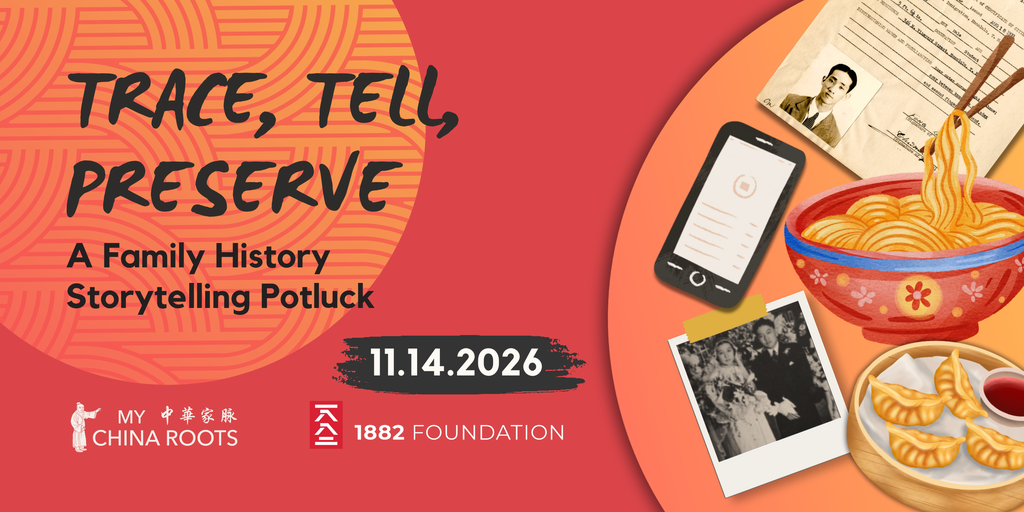
Every family has stories waiting to be shared—tucked inside old photographs, carried in relatives’ memories, or handed down until only fragments remain. Even the faintest story can offer a window into a life once lived and clues for uncovering more. In an age of AI-generated content, preserving these deeply human stories matters more than ever.
Join the 1882 Foundation, My China Roots, and guest facilitators for an interactive day of Chinese family history storytelling. Like a potluck, everyone brings something to the table—a family object, photo, document, memory, question, or simply curiosity—and leaves with expert guidance, complimentary research support, and practical next steps
Through demonstrations, small-group conversations, and community sharing, we’ll explore how to uncover the stories behind family heirlooms, capture memories that may not exist in any archive, and transform family history discoveries into a legacy for others.