Category: Community News

  • NATIONAL ARCHIVES IN SAN BRUNO THREATENED WITH IMMEDIATE CLOSURE

    Take Action Now

    TAKE ACTION with the following steps:

    1. Express your opposition to the closure of the National Archives at San Francisco by writing to:Edward Forst, Acting Archivist of the United States
      National Archives and Records Administration
      8601 Adelphi Road
      College Park, MD 20740-6001
      ArchivistOfTheUnitedStates@nara.govSee below for talking points.
    2. Send copies of your letters to your Congressional representatives. Find their contact information here. In addition, send a letter to U.S. Representative Ro Khanna (CA-17) who sits on the House Committee on Oversight and Accountability, which has oversight over the General Services Administration (GSA). The GSA is the federal agency owns the building where the National Archives at San Francisco is housed.
    3. Email copies of your letters to Save OUR National Archives so that we can track advocacy efforts: SaveOurNationalArchives@gmail.com
    4. Share this call to action with family, friends, and community members: www.SaveOurNationalArchives.org
    5. Sign the petition to save NARA San Bruno here

    TALKING POINTS FOR LETTERS

    Please use your own words to express the importance of keeping these centers open. Here are some ideas for key points to address:

    • State your opposition to closing the National Archives at San Francisco.
    • State that relocating over 100,000 cubic feet of irreplaceable archival materials away from the San Francisco Bay Area – and making them inaccessible without the challenge and expense of travel – removes local communities from their vital history.
    • Share why the National Archives at San Francisco is important to you, your family, and/or your organization.
    • State why you value physical access to original records instead of having only access to digital copies of them. What was it like for you to visit the research room in-person? What was it like to handle original records?
    • Share what you’ve learned about your family or your community from the National Archives.
    • Share how what you have learned from the Naitonal Archives has helped you in your work, school, etc.
    • State that fiscal efficiency should not come at the cost of community identity and historical preservation.

    https://www.saveournationalarchives.org

    NATIONAL ARCHIVES IN SAN BRUNO THREATENED WITH IMMEDIATE CLOSURE;
    ACTION ALERT TO COMMUNITY MEMBERS AND ORGANIZATIONS 

    Save Our National Archives (SONA) is working to prevent the imminent closure of the National Archives and Records Administration (NARA) San Francisco center in San Bruno, California and also opposes the closure of its site in Chicago, Illinois. The NARA website states that the San Bruno facility will be closed within three years and we understand the move could begin as soon as this August, 2026.  SONA has been involved since 1998 to ensure continued public access to these vital archival documents at the San Bruno location. These are invaluable resources, important to the region and the communities documented in them and should not be removed from the region and moved anywhere, in effect cutting off researchers and public access to these vital sources of American history.

    The closure of the regional national archives in San Bruno and Chicago and the consolidation of these materials at locations such as the caverns of the Missouri NARA center which has no research facilities would not only remove the materials from their places of relevance but would effectively cut off public access.  The loss of access to these artifacts and community and genealogical history would be a terrible blow to historians, researchers, families, and students, and ultimately be detrimental to our communities and overall American History.  

    As stated in NARA’s website, regarding the San Bruno location, “The records contain valuable historical information relating to Native Americans, and Americans of African, Chinese, Hispanic, Japanese, Samoan, and other ancestry. Especially notable are records of the Federal district and appellate courts, U.S. Army, U.S. Attorneys and Marshals, Community Services Administration, Fair Employment Practices Committee (World War II), Farmers Home Administration, Government of American Samoa, Immigration and Naturalization Service, Bureau of Indian Affairs, U.S. Navy, and microfilmed records of the Bureau of the Census.”  

    Among these 100,000 cubic feet of documents are hundreds of thousands of immigration and naturalization materials for people from over eighty countries, including extensive Chinese Exclusion case files; German, Italian, and Japanese American internment files; Public Health records; Mexican Land grant cases; Hawaiian Birth Certificates and citizenship cases; and arrival case files for Russian Jews and other immigrants from throughout the world.  

    https://www.archives.gov/san-francisco/finding-aids/ethnic-reference-paper.html

    https://www.archives.gov/san-francisco/finding-aids/holdings-guide-04.html

    https://www.archives.gov/research/immigration/aliens#What%20is%20an%20A-File?

    Direct access to the physical documents and artifacts often belonging to families and communities in these case files is critical, as are the expert staff in San Bruno who are extremely knowledgeable about the holdings and how and where to locate items. Many of the documents are large and fragile, and digitization is unfeasible and would damage them. Within these archives are personal family photographs, family letters, maps of home villages, original wedding, marriage, and birth certificates from countries of origin, tribal artifacts of Native Americans and Native Hawaiian communities, and other sources of community history.  

    Long-standing agreements between the National Archives and the U.S. Citizenship and Immigration Services were made to ensure that historical documents and artifacts important to family history will be made available to the public and not moved from the San Bruno location. This must continue to hold true.  To make these materials inordinately inaccessible to the American people would be a violation of the Freedom of Information Act and to make them disproportionately unavailable to the communities from whose histories they document would be a violation of the 14th Amendment for Equal Protection under the Law. 

    With concerns that files may be moved soon, SONA has launched an immediate letter writing campaign to contact the Archives and is asking writers and organizations to CC their Congressional representatives and ask them to take immediate action. (If possible, email a copy of your letter to us at saveournationalarchives@gmail.com).  

    Please express your opposition by writing to

    Edward Forst, Acting Archivist of the United States
    National Archives and Records Administration
    8601 Adelphi Road
    College Park, MD 20740-6001

    NARA should receive substantially greater funding and serve more people, not reduce access to its important documents that tell the history of this country.  Please also call your members of congress to oppose this terrible action. Access to documents of our national history is foundational to American Democracy and is at the heart and essence of what we celebrate as we commemorate our nation’s 250th anniversary. 

    Please Share Widely!
    For more information and additional sources, please follow us on: FacebookSONA

    “To read a KQED article from June 26, 2026 follow this link.”

    __________________________

    Anna Eng & Grant Din

    SONA, Communications Co-Chairs
    championeerheritagecomm@gmail.com

    grant@tonaidin.net

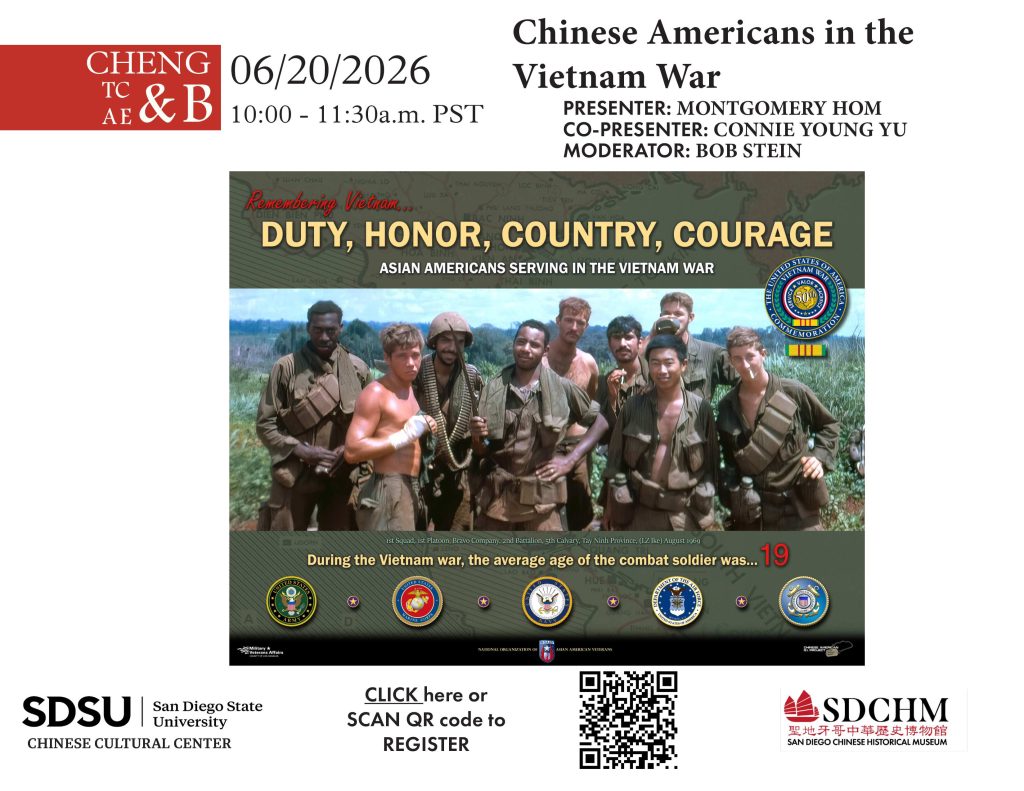
  • Seminar: Chinese Americans in the Vietnam War 6/20/2026

    Registration Link: https://sdsu.zoom.us/meeting/register/lZkk-fw1QFu7rAG8jAvJ6w#/registration

    More than 50 years after the end of the Vietnam War, its legacy remains deeply felt by veterans and the families who lost loved ones. Yet the experiences of Chinese Americans who served in Vietnam have remained largely untold. Only now are some veterans speaking publicly for the first time about their wartime experiences. To preserve and share these stories, the Chinese American G.I. Project is launching an in-depth series focused on the Vietnam War. This upcoming Zoom event marks the first installment in that series.

  • BACGG Founder Receives Two National Honors

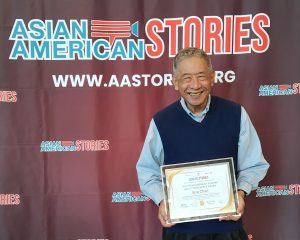
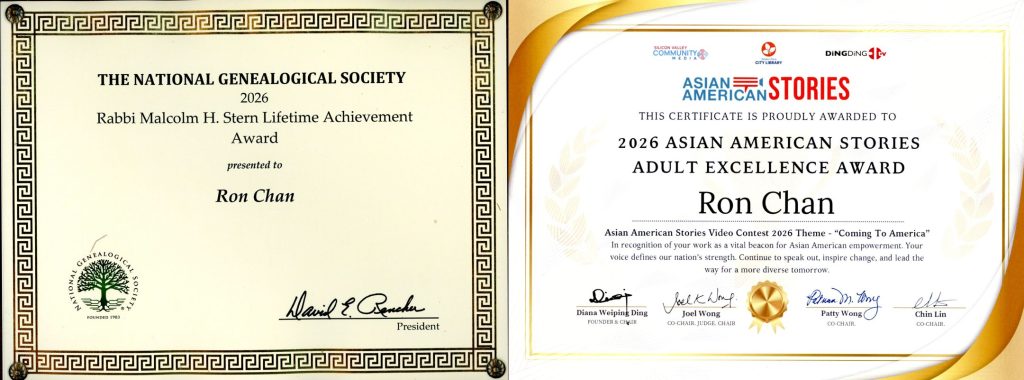
    The Bay Area Chinese Genealogy Group (BACGG) proudly announces that its Founder and Executive Director, Ron Chan, has received two national honors in 2026. The National Genealogical Society awarded Chan the prestigious Rabbi Malcolm H. Stern Lifetime Achievement Award, one of the highest recognitions in the genealogy field, honoring a lifetime of leadership, scholarship, historical preservation, and service to the family history community. Chan was also recognized with the 2026 Asian American Stories Adult Excellence Award for his video “Coming to America,” which preserves and shares the experiences of Asian Americans through storytelling and historical documentation.

    These awards reflect decades of dedication to preserving family histories, advancing Chinese American genealogy, educating researchers, and ensuring that the stories of our ancestors are not lost, forgotten, or ignored. BACGG has become a respected educational organization connecting genealogy, history, technology, and storytelling to help families discover their roots and preserve their heritage for future generations. These national recognitions underscore BACGG’s commitment to excellence and its growing role in preserving and sharing Chinese American history.

    Award Certificates


    2026 Rabbi Malcolm H Stern Lifetime Achievement Award National Genealogical Society

    2026 Adult Excellence Award Certificate Asian American Stories Video Contest
  • If you have recorded an interview with your elder:

    for the next couple of months, I can help you transcribe the interview into text.

    I use the speech to text ElevenLabs https://elevenlabs.io/ to print as plain text your recordings. I use a script (compliments of ChatGpt) to format the output to having the speakers name above their printed text. I have for a short time excess capacity in my ElevenLabs account and will help you format your transcription using my account. I only ask that you proofread the text.

    An example of the output is: https://familyjiapu.com/tree/familyjiapu.ged/individual/I139239279/Pat-Woo

    Please text me at 2095212536 or email me: zhoueysun-genealogy@yahoo.com

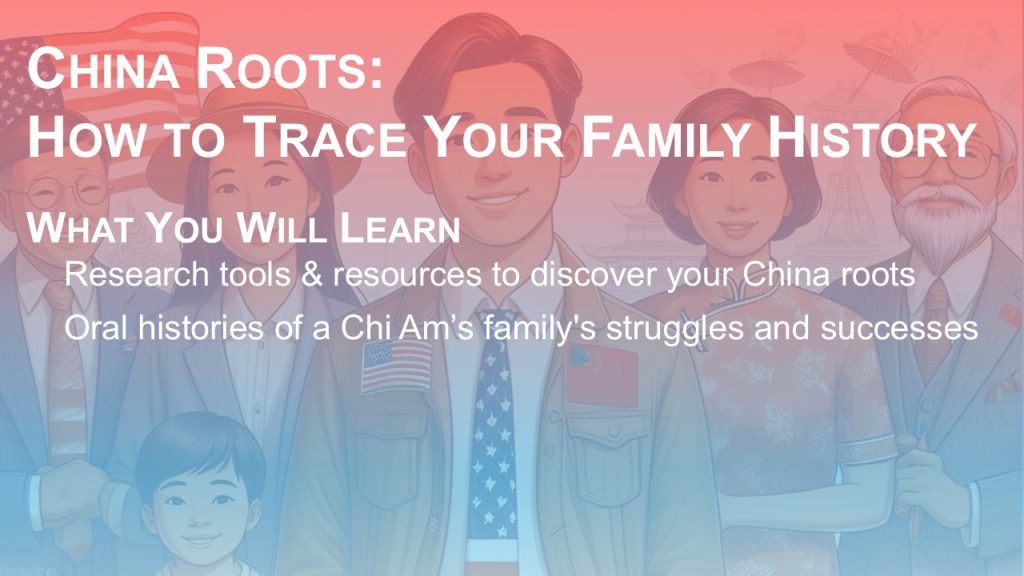
  • Chinese Roots: How To Trace Your Family History

    Genealogy Tools And One Family’s Journey

    FREE

    Mountain View Library, 585 Franklin St, Mountain View, CA, May 23, 2026, 2PM – 4PM

    San Mateo Library, 55 W 3rd Ave, San Mateo, CA., June 13, 2026, Saturday, 1PM-3PM

    PLEASE NOTE THE SANTA CLARA LIBARY, June 13, 2026, Saturday 1PM-3PM has been cancelled.

    What you will learn

    • Research tools and resources to discover your China roots.
    • Oral histories of a Chinese American family’s struggles
    • How 150 generations of family genealogy was found 
    • ChiAm checklist of online, live and local genealogy groups
    • Interviews from Angel Island Immigration National Archives 
    • Experience a visit to a Chinese ancestral village

    Abstract  

    This multimedia session offers key resources to help you find and explore your China roots and access Chinese American research tools. Showcased are the struggles and assimilation of a Chinese American immigrant family through oral histories of hardship, poverty, segregation, discrimination, and a city’s formal apology—80 years in the making—came to life. Unsure of where your ancestral village is in China and how to find your jiapu (ancestral lineage book)? Learn how 150 generations of family genealogy was documented in China. You’ll receive a checklist of research resources – where to ask live and virtual questions, and details on attending a paid three-day Chinese American Genealogy Conference or joining the free Bay Area Chinese Group. Can’t read Chinese? No problem using a Chinese to English translation tool. Discover how the National Archives in San Bruno can help uncover your Chinese ancestors’ interviews at the Angel Island Immigration Station, where 175,000 Chinese immigrants entered the U.S. between 1910 and 1940.

    Session Time: 2 hours

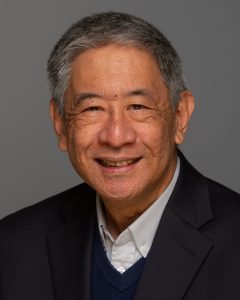
    About The Speaker: Ron Chan

    Ron Chan is a passionate storyteller, educator, and recognized leader in Chinese American genealogy. As Founder and Executive Director of the Bay Area Chinese Genealogy Group (BACGG), Ron inspires people to discover their family roots, preserve their heritage, and ensure the stories of those who came before them are never lost. A seasoned lecturer and published genealogy author, he brings genealogy, history, technology, and storytelling together to make family history engaging and accessible. Ron is also co-founder of the Chinese American GI Project, preserving the stories of Chinese American veterans. In 2026, Ron received the prestigious National Genealogical Society Rabbi Malcolm H. Stern Lifetime Achievement Award.

    Here are some session feedback

    “I watched and learned your family history journey where you shaped and built info into one powerful presentation. Lots of good teaching tips, use of resources.”

    “Comprehensive, using multimedia and storytelling to keep the one-and-a-half-hour presentation engaging and compelling.”

    “Wonderful combination of all your years of research. Thank you for all your tips and technologies, and all your HEART!!!”

    “Great ancestor name reference chart to organize family information.”

     “Very informative. Good combinations of instruction and entertainment. Very good resources. Very inspirational for those just starting out.”

    “Excellent resource list from Ron’s personal experience. Excellent examples of what is possible. All these memories are relatable to my family. Very much appreciated. Loved the chapter on the social environment from the 1920s through the 1950s i.e. discrimination, segregation, which answered some questions for me.”

    “The presentation videos were very informative and interesting. I like the personal touches and inspires me to do the same with my own Family History.”

    “Ron gave an excellent overview of the resources available on where and how to research Chinese  history. It helped when he personalized it using his own family history. By giving examples of what can be done with the tools available, makes it seem practical. It was great to have built in tips by using the “ring“ to inform when to take a photo of the slide. Providing all links in the summary was very helpful.”

    “I’m glad I came to this presentation. I know now how to proceed in gathering all the information and documenting it to pass on to my family and relatives to leave a legacy of our roots to the future generations. Thank you, Ron!”

    “Excellent tools, touching stories, terrific delivery – greatly appreciated the time, effort, thoughtfulness, and generosity of sharing. I am privileged to be affiliated with Ron and the Bay Area Chinese Genealogy Group and look forward to supporting greater partnerships with the Chinese Historical and Cultural Project. Thanks Ron for your focus and leadership.”

     “Excellent and very thorough. Have been to my family village.”

    “Excellent information and resources. The tips went to take pictures is very useful. Everything will be useful in my research.”

    “Excellent variety of topics.”

    “Very thorough and inspiring for people/attendees to start or continue their genealogical quest. Reference resources alone are valuable. Kept the light touch with sporadic bits of humor/levity keeps it from being dry.”

    “Good information. Well presented.”

    “Well organized. Build and flow smoothly. Excellent information. Visually stunning, clever, creative. Able to hold interest throughout. Has great heart and personality. Family stories were extremely touching.”

    “Learning about Google Translate from pictures is worth the price of admission alone.”

    “Your in-depth detail of your many generations of Family History was truly outstanding and I believe no other can duplicate all your efforts.”

    “Good resources and family stories.” 

    “What a great introduction to so many sources, sharing personal stories – very heartfelt. Excellent!!! I am having a better and better understanding for my small and growing interest and research for my grandmother‘s Chinese birth, father and my Family Tree. Thank you so much.”

    “This was an excellent presentation, thorough, it’s intimidating to try to do as much as Mr. Chan has done for his family. I especially appreciate the sharing of resources since I am unaware of many of them especially those specific to Chinese roots.”

    “Ron Chan’s presentation was clear, understandable, chock full of info, resources, data and VERY ENTERTAINING. Thank YOU!”